Two women are killed every week in England and Wales by a current or former partner. Most people, walking past a statistic, keep walking. Women’s Aid and WCRS decided the problem was not awareness. It was attention. In 2015, they built a billboard that could tell the difference.
The Technology
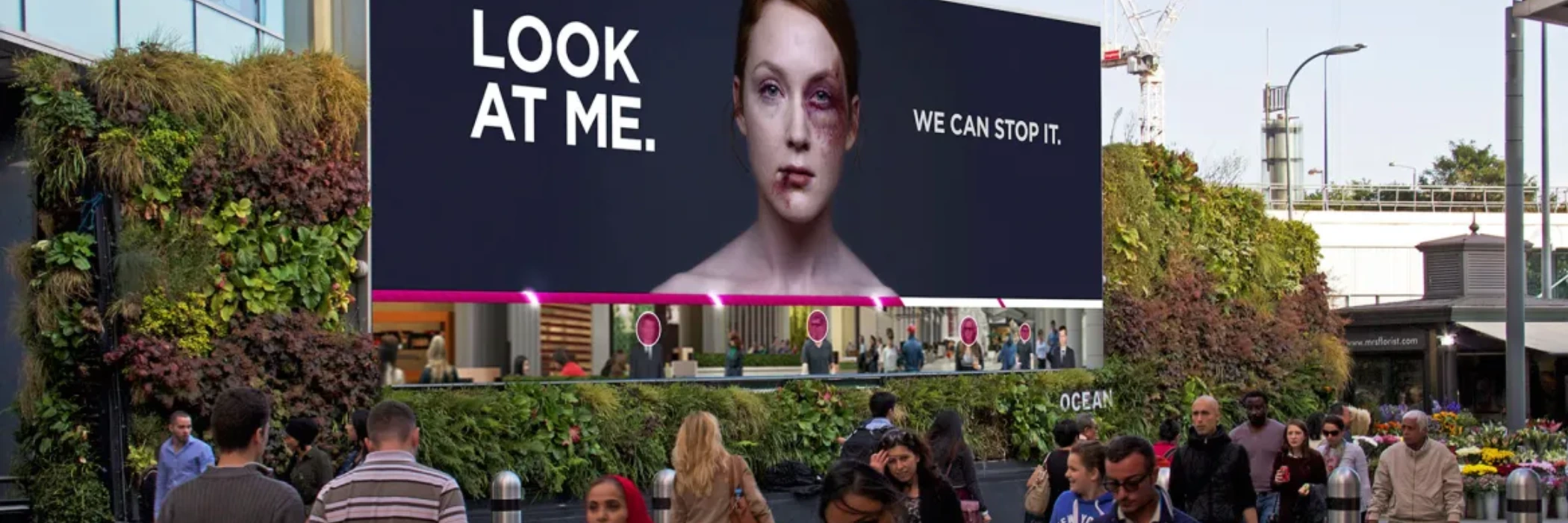
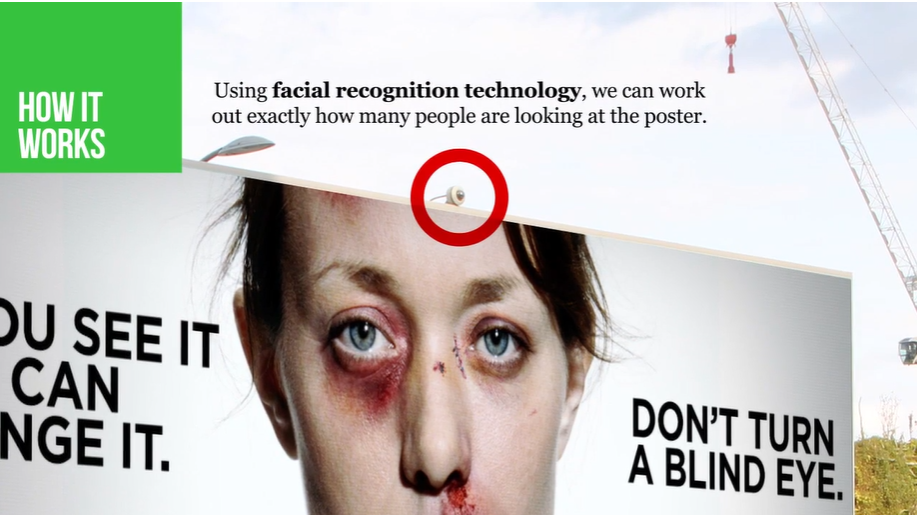
The campaign, titled “Look at Me,” ran on digital outdoor screens at Canary Wharf in London, timed to International Women’s Day. The screen displayed a photograph of a woman with visible bruises and cuts across her face. Two cameras embedded in the unit tracked the gaze of people passing in front of it, using facial detection technology developed in partnership with Ocean Outdoor.
When no one was looking, nothing changed. The bruised face remained on screen, unacknowledged, as most passers-by moved past without stopping. When someone stopped and looked directly at the screen, the technology registered their attention and began to alter the image. Her bruises slowly faded. Her face began to heal. The longer they looked and the more people who stopped, the faster and more completely the healing progressed. If people turned away, the process reversed.
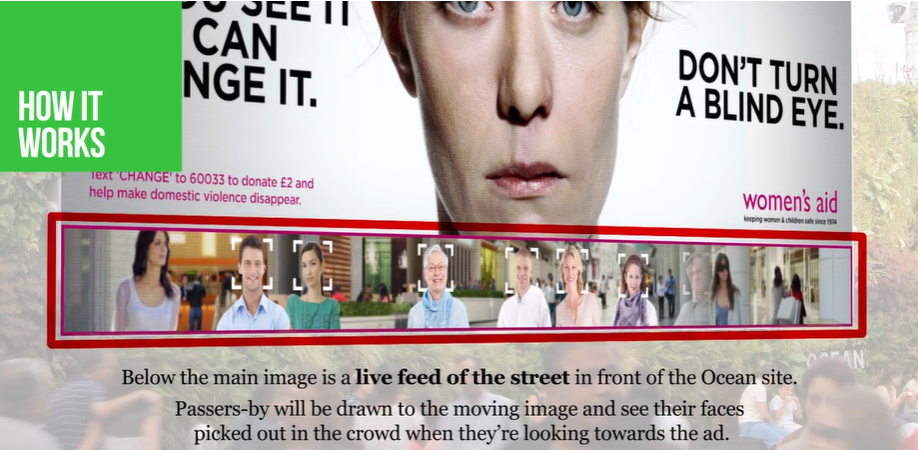
A live video ticker ran along the bottom of the billboard in real time, showing webcam footage of everyone walking past and registering the growing number of people who had stopped to look. The social count made the act of paying attention visible to other passers-by, creating a feedback loop between individual attention and collective progress on screen.
The Mechanism as the Message
Dino Burbidge, director of innovation and technology at WCRS, described the technical operation in the simplest terms: “Walk past, it recognises you, takes no data from you, but it just adds you to a progress chart. Underneath, it’s actually very complicated, but the technology is invisible, and that is how we wanted it to be.”
The invisibility of the technology was the point. The billboard did not ask anyone to donate, sign a petition, or visit a website. It asked only for eye contact. The campaign’s central argument is contained entirely in that mechanic: domestic violence persists partly because people look away. The billboard made looking the intervention. Attention was not a prelude to action. It was the action.
Polly Neate, chief executive of Women’s Aid at the time, explained the psychological insight behind it: “Often people don’t want to see domestic violence or do something about it because it feels too difficult or they’re worried what they do won’t have any impact. They turn a blind eye because of this, leaving women isolated and making it even harder for them to get help.”
The billboard turned the act of not turning a blind eye into something measurable, visible, and cumulative. Every person who stopped changed the screen. Their contribution was recorded in real time and fed back to them and everyone around them. The collective progress toward a healed face was a live visualisation of what sustained public attention could produce.
The Reach It Achieved
The “Look at Me” campaign generated media coverage across 20 countries and reached an estimated 326.9 million people, a figure that reflects the global spread of news and social media coverage rather than the physical footprint of a single outdoor screen in Canary Wharf.
It won the Grand Prix at The Drum Creative Out of Home Awards, the Interactive Award at Ocean Outdoor’s Art of Outdoor competition, and multiple additional honours at the Festival of Marketing. The judging panel at the Art of Outdoor competition described it plainly: “This campaign figures out how many people are looking at the screen, and the longer you look at it, the more it changes. This has not been done before. So, paying attention has a positive effect. It’s very clever.”
The Preceding Work and the Broader Platform
The “Look at Me” billboard was preceded by “Blind Eye,” an interactive cinema experience WCRS and Women’s Aid had built together using the same core technology. In that execution, a film played in a cinema and the image on screen changed based on whether the audience was watching or looking away. The cinema format established the proof of concept. The outdoor billboard scaled it to a public environment where the passers-by had not opted into the experience and had no expectation of what they were walking past.
Both executions share the same structural argument: the opposite of action in domestic violence is not inaction. It is avoidance. The technology in both campaigns converted the act of looking, which every person is physically capable of, into a measurable form of support. It did not ask for money, signatures, or time. It asked for the one second required to stop and see what was in front of you.
Campaign Name: Look at Me
Agency Name: WCRS / Media partner: Ocean Outdoor
Brand Name: Women’s Aid
Location: Canary Wharf, London, United Kingdom